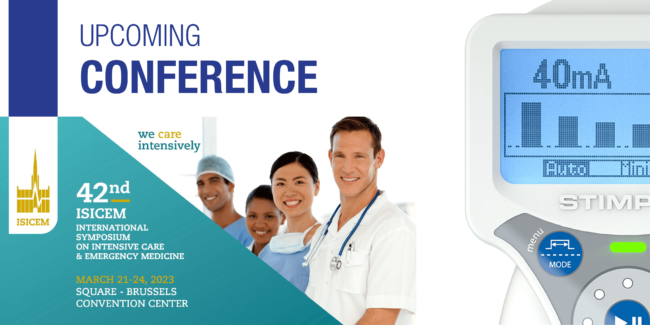
Brussels, Belgium (21-24 March, 2023) – The International Symposium on Intensive Care and Emergency Medicine is organised in collaboration with the Departments of Intensive Care and Emergency Medicine of Erasme University Hospital, Université Libre de Bruxelles, and with the Belgian Society of Intensive Care Medicine (SIZ). Started in 1980, this meeting has become established as…
If a picture paints a thousand words, a hashtag #PaintstheWholePicture! #eliminateRNB2025 embodies our mission to eliminate residual neuromuscular block in patients around the world by 2025. This is an important goal, as residual neuromuscular block can cause increased oxygen desaturation, postoperative pneumonia, airway obstruction, and reintubation, as well as increase healthcare costs associated with these…
Bremen, Germany (15-17 February, 2023) – Finally it’s that time again, after a two-year break, the Intensive Care Medicine + Intensive Care Symposium is opening its doors again! For everyone who cares about the best possible care for intensive care patients! Come and experience the STIMPOD NMS450X at the 31st Intensive Care Medicine and Intensive…
The latest guidelines from the American Society of Anesthesiologists (ASA) and the European Society of Anaesthesiology and Intensive Care Medicine (ESAIC) provide important recommendations for quantitative monitoring and antagonism of neuromuscular blockade. These guidelines are based on recent evidence-based research, and they place particular emphasis on using quantitative monitoring. Let’s look at the four main…
Ögiain, Vienna, Austria (15-18 February, 2023) – The STIMPOD NMS450X will be exhibited at the 41st Vienna Intensive Care Medicine Days. You can learn more about the STIMPOD NMS450X here. Download the full scientific programme at https://www.wit-kongress.at/ Visit Eumedics and see the STIMPOD NMS450X Objective NMT Monitor in action! The 1st handheld multi-sensor NMT monitor, with both AMG…
The Stimpod NMS450X+, equipped with two different modalities (AMG and EMG), empowers anaesthesiologists to achieve safer intraoperative control of patients’ neuromuscular blockade. The full case NMT Monitoring enables safe extubation and eliminate residual paralysis in any hospital setting, provider preference and surgery type. This advanced technology empowers clinicians to have a safer and more precise control over the neuromuscular blockade during surgery, aligning with the latest guideline-concordant recommendations for the monitoring of patients for residual paralysis following the administration of a neuromuscular reversal agent. The ASA and ESAIC strongly recommend the use of a quantitative neuromuscular blocking agent monitor in conjunction with neuromuscular blocking agents.
While reversal drugs like Sugammadex are commonly used for NMBA reversal, they are not a foolproof solution and residual paralysis remains a significant concern based on clinical evidence. By incorporating the Stimpod NMS450X+ into their practice, anaesthesiologists can proactively monitor the depth of neuromuscular blockade, significantly reducing the incidence of residual paralysis in patients. This contributes to improved patient outcomes and a safer post-operative recovery.
The Stimpod NMS450X+ offers a cost-effective solution in the OR, PACU and ICU. With its two modalities, AMG and EMG, the device provides flexibility in monitoring options. The only neuromuscular monitoring system available with both AMG and EMG enabling cost control at the point-of-care based on need and specific setting, allowing affordable standardisation across the entire hospital. Cost of Care model, enabling monitoring of all drug usage to ensure optimal use, thus saving on both paralytic and recovery agents. This cost-saving feature ensures efficient resource management without compromising patient safety.
AMG offers the most cost-effective option to implement with a reusable sensor and versatile patient setup options enabling neuromuscular transmission monitoring of the hand, toe or face.
EMG is ideally suited for neuromuscular monitoring of surgeries where tucked hands and arms are required, with optimised performance through a patented, skin-like electrode.
Residual neuromuscular blockade after anaesthesia has been linked to severe complications and adverse outcomes, including increased oxygen desaturation, postoperative pneumonia, airway obstruction, and reintubation. By utilizing the Stimpod NMS450X+ and effectively preventing residual NMB, clinicians can contribute to reduced LOS in hospitals and improve patient recovery rates.
Anaesthesiologists worldwide who have adopted the Stimpod NMS450X+ demonstrate their commitment to following the latest guidelines and best practices in anaesthesia. By incorporating a quantitative NMBA monitor into their practice, clinicians align themselves with the recommendations set forth by the ASA and ESAIC, promoting a higher standard of care and patient safety. By utilizing the Stimpod NMS450X+, anaesthesiologists are a testament to its effectiveness to improve patients outcomes and can contribute to the reduction of adverse events and enhance the recovery process for their patients.
This website or its third-party tools use cookies, which are necessary to its functioning and required to achieve the purposes illustrated in the cookie policy. If you want to know more or withdraw your consent to all or some of the cookies, please refer to the cookie policy. By closing this banner, scrolling this page, clicking a link or continuing to browse otherwise, you agree to the use of cookies.